We need the rain. That’s what I kept telling myself as I did my best to avoid puddles on my way to the gala performance at San Francisco Ballet. It was a cold and wet evening for ballet-goers, but that did not stop anyone from wearing their finery—which is one of the main draws to attend the gala in the first place.
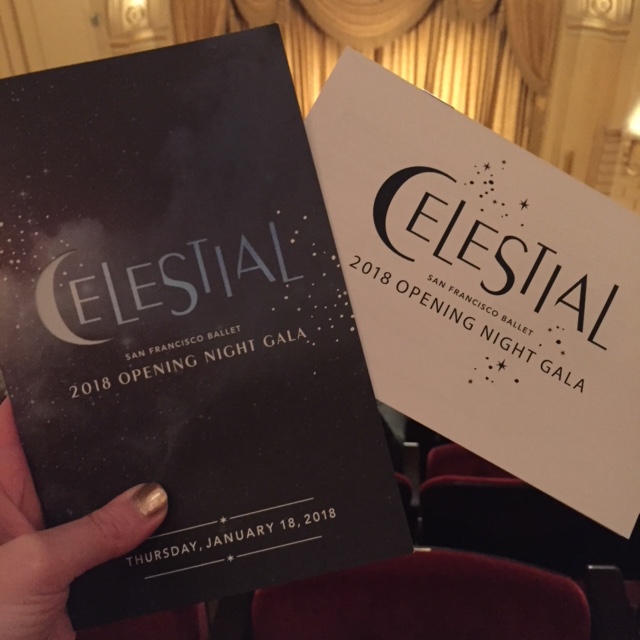
I am always surprised when the evening begins with the orchestra playing The Star Spangled Banner. This isn’t a baseball game! I have no idea why it was played at the top of San Francisco Ballet’s opening night gala, but this year, as hundreds of people in formalwear got to their feet, I found myself thinking about the upcoming Olympic Games. “It’s like we’ve all won gold medals!” I thought. Following the national anthem, the chairman of the Board provided a few opening remarks. It made for a long, slow start to a long performance. We were there, after all, for the dancing.
And the dancing was very good. Sasha De Sola and Angelo Greco were suitably spectacular in their delivery of the technical feats in the pas de deux from Le Corsaire. (The woman seated next to me was practically bouncing up and down in her seat she was so excited by Greco’s manège.) Ulrik Birkkjaer’s fleet footwork was a wonderful look at the Bournonville style. And Justin Peck’s Rodeo was a great showcase for the company’s men.
But the flow of the evening felt off. The shift from Jerome Robbins’ romantic In the Night to the “Bluebird” Pas de Deux from The Sleeping Beauty was jarring, although it wasn’t nearly as bad as the shift from Edwaard Liang’s Letting Go, choreographed in 2015, to La Sylphide, which premiered in 1836. What’s sad for me is that the more classical pieces suffered in these juxtapositions. “Bluebird,” which is a famous and challenging pas de deux from the classical canon, seemed almost lifeless after the intimacy of In the Night. La Sylphide, out of place on the program in general, was done a huge disservice by following Letting Go. In comparison, La Sylphide seemed incredibly staid, and I think many in the audience were confused by Birkkjaer’s kilt.
The evening was, essentially, a series of pas de deux. And by the time we got to La Sylphide, I had decided that it would have been both interesting and educational to present the ballets in chronological order. What a pas de deux is, how it is conceived and constructed, has changed significantly over the last 150 years. There seems no relation between La Sylphide and Letting Go—but if you see the intervening years, it starts to make sense. In chronological order: La Sylphide, “Bluebird” (The Sleeping Beauty), Le Corsaire, Stars and Stripes, In the Night, Rodeo, Letting Go, Children of Chaos. There is not a direct line, of course, from La Syphide in 1836 to Children of Chaos in 2017. But there’s a definite evolution of the pas deux. In the excerpt from La Sylphide, there’s fairly little partnering, with the couple dancing for each other almost more than with each other. By the time you get to the ballets of the 2000s (Rodeo, Letting Go, Children of Chaos), a pas de deux is almost entirely partnering, with the woman extremely dependent on the man to lift her, turn her, bend her. This is fascinating to me, and I like to think that the audience would have appreciated being able to follow along.
The other thing that I increasingly find with the gala-type format is that many pas de deux do not work out of context. Again, people were confused by the sudden appearance, at the end of the evening, of a woodland backdrop and a man in a kilt. Stars and Stripes, which is humorous, did not quite read as such. “Bluebird” is far grander when placed amongst the rest of the third act of The Sleeping Beauty. In the Night, Rodeo, and Letting Go were all performed in their entirety, which perhaps explains why they felt, at least to me, like complete compositions. They were.
I want to talk about Robbins and Chopin, but I will do that when I see Program 5. I want to talk about Justin Peck’s Rodeo, but I will do that when I see Program 2.
All told, it was an enjoyable evening of dancing. I would have appreciated a few more tastes of what is to come in the rest of this repertory season, but that being said, I was happy to see ballets that I otherwise may not see for some time. Between now and May, San Francisco Ballet will present five programs of full-length and repertory fare, four programs of new works (as part of Unbound, their festival celebrating new work), and an appearance by the National Ballet of Canada. It’s a busy spring. Let the fun begin!
San Francisco Ballet Gala 2018
January 18, 2018, at 8 pm at the War Memorial Opera House
 Going to the Ballet