On Tuesday, I went and saw The Royal Ballet cinema relay of La Bayadère. On Wednesday, I went and saw San Francisco Ballet’s In Space & Time, a triple bill of works by Helgi Tomasson, Cathy Marston, and Harald Lander.
That was the wrong order in which to see the performances.
La Bayadère is (another) one of those long classical ballets that I don’t get excited about seeing. But I forget, every time, how much dancing there is. And when the cast is led by Marianela Nuñuz, Vadim Muntagirov, and Natalia Osipova—well, it’s excellent dancing. Ms. Nuñuz was almost too perfect as Nikiya, while Ms. Osipova got to have a great deal of fun as the conniving Gamzatti. It wasn’t the most compelling emotional performance I’d seen from these dancers, but that hardly mattered. As I said recently regarding Don Quixote, you don’t go to Bayadère for the story. You go for the dancing.
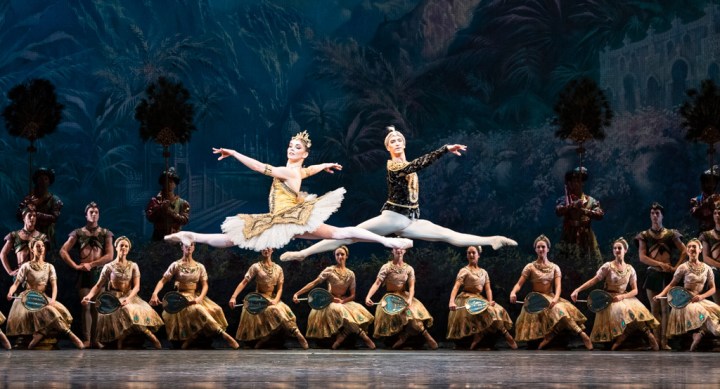
La Bayadère is most famous for its second act, the Kingdom of the Shades, often performed as a self-contained excerpt. And the Kingdom of the Shades is most famous for the entrance of the 24 shades, executing a series of 39 arabesques as they descend a ramp and wind their way around the stage. It’s really very special. Once they arrive in their places, they keep going, slow and steady and in perfect unison. The audience always cheers at the end. The Kingdom of the Shades also includes three variations, exquisitely danced in the cinema broadcast by Yuhui Choe, Yasmine Naghdi, and Akane Takada. Finally, it includes a pas de deux for the principal couple in which he partners her via a long, diaphanous scarf. It’s fiendishly difficult, and Ms. Nuñez did it as she did everything else, seemingly without any effort at all.
In London, Ms. Nuñez and Ms. Osipova were alternating in the roles of Nikiya and Gamzatti opposite each other. It would have been such fun to go to both and do a compare and contrast!
[If you’re curious to see the Kingdom of the Shades, you can watch a clip of the Paris Opera Ballet here.]
Unfortunately, San Francisco Ballet was coming up against that performance when my mom and I attended Program 03: In Space & Time. To be fair, the company looked good in Helgi Tomasson’s The Fifth Season, and in Cathy Marston’s Snowblind in particular. But it fell apart a bit in Etudes, and that ended the evening. It’s always the last thing you see that sticks with you.
Snowblind had been a highlight for me at its Unbound premiere last season. I was glad to see it again. Waiting for the train, my mom asked me to find a synopsis of Ethan Frome, on which Snowblind is based. Sparknotes returned a very lengthy summation which I skimmed, before saying, “It’s pretty much exactly what we saw.” The summary contained lots of detail, but the essential plot is that a man married to a sickly wife falls in love with her caregiver, and they all live unhappily ever after. That is exactly what Marston gives us onstage in Snowblind. It’s clearly told, and she successfully creates not only a world onstage but also a feeling, so that you as the audience become invested. (Or, in the case of the elderly woman two seats down from me, fall asleep. Oh dear!)
Tomasson’s The Fifth Season was elegantly attired and elegantly danced. It was nice to see so many soloist and corps dancers featured—it seems to be a season full of young debuts.
Harald Lander choreographed Etudes for the Royal Danish Ballet in 1948. In my post on Program 02, I said ballet students should see Balanchine’s Divertimento No. 15 because of the basic classwork that comes through. In this case, I think audiences should see Etudes for a crash course in ballet. Etudes opens with a solo ballerina doing a grand plié in fifth position. She curtsies and exits and the ballet begins, as every ballet class begins, at the barre.
At first, you can only see the dancers’ legs and arms—they’re illuminated, but the rest of the stage is dark. The barres get rearranged, and then you can only see them in silhouette; they’re still anonymous. But then the barres are carried offstage and the lights come up to full and suddenly they’re dancing. Really dancing! The whole of ballet is based on a few basic steps that start at the barre: pliés, tendus, relevés, rond de jambes. From these, there are infinite combinations and variations. At the barre, the steps seem to be no more than exercises. It’s not until they get strung together that they look like dancing. The whole point of it all is the pirouettes and jumps; movement on a big scale.
Etudes doesn’t quite capture that euphoric feeling. But it does indeed show the progression. The dancers move through basic pirouettes to fouetté turns, from small jumps to giant leaps across the diagonal of the stage. It even moves through the eras, with a stop in the Romantic era (fittingly, as the Royal Danish Ballet is famous for La Sylphide).
I am pleased to say that the corps was much more in unison than they had been in the excerpt performed at the gala last month. However, there were bobbles galore, and in a ballet like Etudes, every mistake may as well be lit up in neon lights. I think one could generously call it an uneven performance.
But that’s live theater for you! Different every time, sometimes superhuman and sometimes entirely human.
[Some kind ballet lover has uploaded the entirety of Etudes, performed by the Paris Opera Ballet, here.]
The Royal Ballet: La Bayadère
Cinema relay broadcast locally on February 19, 2019, at 7 pm
San Francisco Ballet: Program 03: In Space & Time
February 20, 2019, at 7:30 pm at the War Memorial Opera House
The Fifth Season, Helgi Tomasson; Snowblind, Cathy Marston; Etudes, Harald Lander
 Going to the Ballet
One thought on “Back to Back Ballets”
Comments are now closed.