Recently, I suggested that I could have a whole separate blog dedicated to the adventures I encounter in pursuit of going to the ballet. In January, it was an Airbnb gone wrong. Last month, it was an impromptu overnight with family in Phoenix. This time, it was an earthquake. I’m getting concerned; the level of adventure is definitely increasing!
So yes. Looked at from a certain perspective, The Royal Ballet’s Friday evening performance in Los Angeles of Kenneth MacMillan’s Mayerling was literally moving. Fortunately, the earthquake (7.1, about 125 miles from the venue) occurred during intermission. The earth shook, the chandeliers swayed, and I bought a brownie at the bar. But I did wonder: what would have happened if it had been mid-act?
I had not seen Mayerling (pronounced MY-er-ling) live before, although I do have it on DVD. And thank goodness, because the synopsis provided in the program was woefully inadequate for a story of this complexity. The DVD provides extensive plot summary, which I found myself deploying at intermission to a pair of patrons (“I kept getting confused between the wife and the mistress.”).
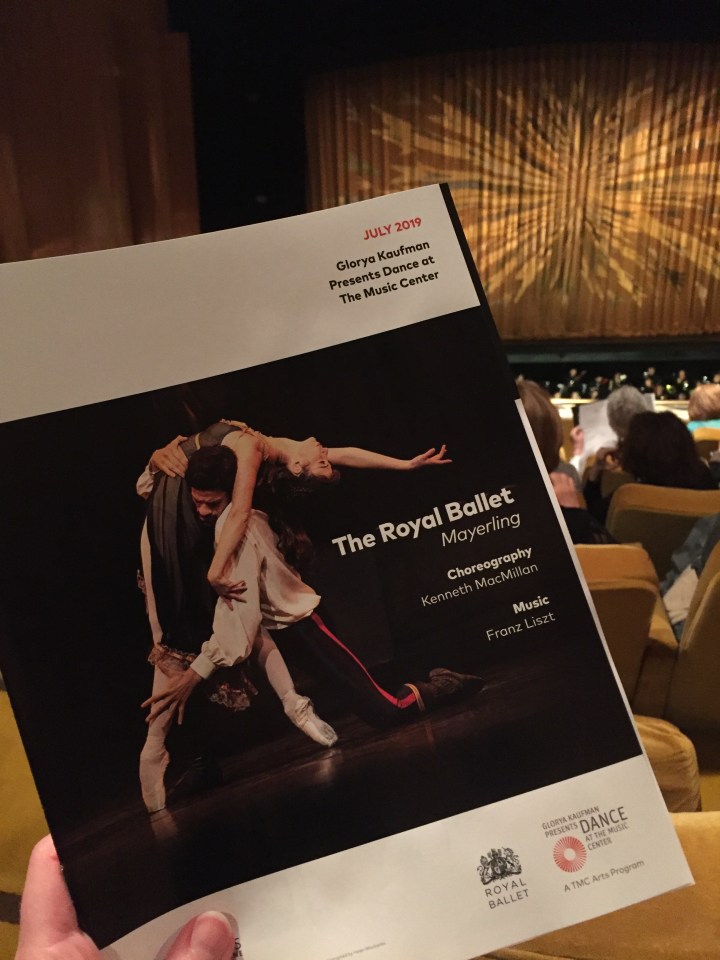
Mayerling belongs to the male lead in what must surely be one of the most exhausting roles created. Crown Prince Rudolf dances with no fewer than five main female characters, primarily in tremendously athletic pas de deux. It’s also a role that calls for the dancer to really act and express. Rudolf is no fairy tale prince. He’s based on a historical figure who suffered from enough mental distress to carry out a suicide pact with his teenage mistress.
This is not, to my mind, a natural choice for a ballet. But the vast plot calls for a number of important supporting roles, danced as often by principals as by up-and-coming soloists. On Friday night, six of the Royal’s principals performed: Ryoichi Hirano, Natalia Osipova, Sarah Lamb, Marianela Nuñez, Francesca Hayward, and Alexander Campbell. A starry night, indeed. On Sunday, Thiago Soares and Lauren Cuthbertson danced the leads, with a less famous but still excellent supporting cast.
Hirano is an elegant dancer. I had been impressed with him in a cinema broadcast of The Winter’s Tale a year ago so was excited to see him in this role. His Rudolf was less obviously troubled at the outset, although by the pas de deux with a cowering Hayward as his bride, the signs of his instability were there. Their pas is difficult to watch as he terrorizes her, but I was struck by Hayward’s approach. She was stiff as he partnered her, clearly conveying her fear and reluctance to be with her husband. (Toward the end of this pas de deux, you could hear them panting, their exertion evident. It made it very real and very human.)
Osipova, opposite Hirano, was a force of nature*, almost from the get-go. I didn’t think she was suited to the domestic scene in which her character is fully introduced. She was believable as the passionate Mary Vetsera who dances with Rudolf, but not as the teenager with a crush who sighs over his portrait at home. Once the two of them were together, though, it was clear that Rudolf had met his match. MacMillan’s choreography has a lot of lifts that consist of the woman practically throwing herself into Rudolf’s arms, and the intensity that both Osipova and Hirano brought was palpable. Their pas de deux were all fevered romance: head-over-heels and fatal.
Cuthbertson, dancing Mary Vetsera opposite Soares, had more of an arc. She seemed right at home in the aforementioned domestic scene—which made it all the more stunning to witness the transformation in her next scene, when she arrives in Rudolf’s room wearing only a negligee and an overcoat. The confidence with which Cuthbertson imbued Vetsera was impressive and nearly gave her the upper hand of Soares as Rudolf. She was almost predatory in her flirtation. But then, later, before their final pas de deux, she was tender, giving Rudolf the emotional support he clearly needed. I preferred Cuthbertson in the role, although I had no objections to Osipova until I saw Cuthbertson.
Soares is retiring from The Royal Ballet, and this may well have been his final performance as a full time principal with the company. His Rudolf seemed older and wearier than Hirano’s, combating his demons from the beginning. He has a solid presence, even just standing there. Not quite as princely as Hirano, perhaps, but more commanding.
As for the supporting cast…
Sarah Lamb, on Friday, surprised me with her excellent portrayal of Marie Larisch, Rudolf’s former mistress. She’s a conniving character, the mastermind behind much of the drama, and has such a large supporting role that she actually bows with Rudolf and Mary Vetsera at the curtain calls. Lamb brought something unexpected to the part: she seemed to really love Rudolf. When his mother discovered her in his room after a hunting party gone wrong, Lamb seemed genuinely concerned about Rudolf.
Alexander Campbell was a delightful Bratfisch on Friday. I was especially taken with his Act 3 solo in which he dances for Rudolf, who isn’t even watching. He seemed offended, imploring Rudolf to look his way, begging for the attention. Paul Kay, on Sunday, played it more aggrieved, as if he knew what Rudolf was plotting and had already begun to mourn.
Marianela Nuñez as Mitzi Caspar (Rudolf’s “regular” mistress, according to the program) got an enormous round of applause when the curtain rose on Act 2 before she had even done anything—she’s a ballet superstar beloved by many, and it was a treat to see her. I can’t say for sure, but she seemed cast against type as Mitzi and was having fun with it.
Francesca Hayward, as mentioned above, made the most of her role as the unfortunate Princess Stephanie. Aside from her pas de deux with Rudolf in Act 1, she was in the background. On Sunday, Anna Rose O’Sullivan, was also very good in the part.
The Four Hungarian Officers, whose stage time could do with some serious editing in my opinion, finally get to dance in Act 2. I think it was Cesar Corrales who led things off on Friday night, blazing across the stage. We should keep an eye on him. The Four Hungarian Officers show up throughout the ballet, always lying in wait for Rudolf to argue their cause. These scenes are many and tedious, and I believe their only purpose is to provide cover for the set change happening behind them.
One detail of the ballet that I must mention, because I like it so much, is the inclusion of the song sung at the emperor’s birthday party in Act 2. The royal family gathers for entertainment, which includes live musicians. A minor character sings an entire song and no translation is provided, but the audience grows to include the dancers onstage, who take their seats and listen attentively. Dancers and audience alike applaud at the end. To me, it is a moment of real life that has been incorporated into the ballet that helps affirm that this story is taken from history rather than invented.
[If you would like to see a clip of Mayerling, you can watch Sarah Lamb and Steven McRae here.]
The Royal Ballet’s tour consisted of Mayerling and a performance featuring a collaboration with Company Wayne McGregor the following weekend. I picked one to attend. For people in the Los Angeles area, how great to get to see the company twice in such different programs.
I was thrilled to see The Royal Ballet, which I have a soft spot for, live and in person without having to go all the way to London. The trip was worth it, earthquake and all.
*I did not realize when I wrote this that “Force of Nature” is also the name of a documentary about Osipova, recently released in the UK.
The Royal Ballet: Mayerling
July 5, 2019, at 7:30 pm, and July 7, 2019, at 2 pm at the Dorothy Chandler Pavilion
 Going to the Ballet
2 thoughts on “The Royal Ballet on tour: Mayerling”
Comments are now closed.