Coppélia and Cinderella. And, lest you be concerned, for cookie, which I consumed in chocolate-mint form during intermission at the opera house.
San Francisco Ballet’s season began with Christopher Wheeldon’s Cinderella. I had tickets for opening night, but that was the same night as the Royal Ballet’s cinema broadcast of Coppélia, and there was no question in my mind that Cinders would get bumped in favor of seeing that.
I know several people who don’t care for Coppélia. They find it silly or old-fashioned, or feel that Franz is too much of an idiot. The story is certainly silly, though I would argue no sillier than many other ballets, and to me the ballet is utterly charming. I had forgotten how wonderful the score is, full of highly danceable music that ranges from bright and cheerful to lush and adagio. It’s also chock-full of dancing, start to finish. No one could ever accuse Coppélia of not having enough opportunities for the dancers, from corps through principals.
If you are not familiar with Coppélia, here is a very brief primer. The ballet has perhaps the most misleading title in all of ballet, as Coppélia is in fact a life-size doll around whom the plot revolves, rather than the main character. That is Swanilda, a vivacious and rather bossy village girl, who is in love with Franz, a foolish village boy, whose eye is caught by Coppélia, a life-size doll. All is set right in the end and Swanilda and Franz live happily ever after.
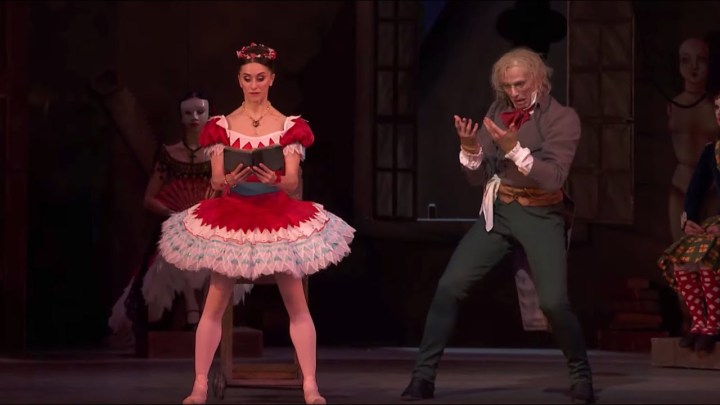
The cast in this performance was led by Marian Nuñez, who appeared to be having a blast in a less tragic role, and Vadim Muntagirov, who, in an interview, said he was basically playing himself. The ballet really belongs to Swanilda, and I don’t get the sense that the part receives full credit for how difficult it is. Act II is essentially all Swanilda, with at least two variations as well as an extended sequence where she has to be believably doll-like.
I think the only other time I have seen Coppélia was as a girl when the Ballet Nacional de Cuba came to Berkeley. However, we did learn Swanilda’s opening variation in class, with particular emphasis on the pantomime. Swanilda is unsuccessfully trying to get the attention of Coppélia, who is reading in a balcony window. Our teacher taught us the mime, along with words to help us remember the order, which we then sang to the music. It’s probably been 20 years since that class, but I still remember the mime, the words, and the music. Clearly that was a successful teaching moment!
Someone has posted the entirety of Act I from the cinema broadcast on YouTube. It is 38 minutes. If you have time to spare, or if you’re sick in bed, or if you’re just interested, it is well worth a watch.
So, having changed my ticket (subscriber perk!), the following night I went to see SFB in Cinderella. A co-production with Dutch National Ballet, it premiered in San Francisco in 2013. I wasn’t here for that, but I did see it during the 2017 performance season. That viewing pre-dated this blog, so we’ll never know exactly what I thought then. My recollection, however, was that it was “fine.”
And indeed it was. The most and the best dancing is all in Act I, which takes us from Cinderella’s mother’s death through her departure for the ball. Wheeldon’s ballet pulls more from the Brothers Grimm version of the fairy tale than from Charles Perrault, which means there’s no fairy godmother. I found that rather sad. It’s perfectly nice having a magical tree that represents her mother that provides for her, but the godmother really makes it a fairy tale.
Compared to Coppélia, there seems to be very little dancing at all. Someone I know without a ballet background even observed, before I could, “There’s not much dancing.” This is probably my most common complaint. You’ll see it repeated throughout my writing about new full-lengths.
That being said, Dores André was a lovely Cinderella, gracious and demure and entirely deserving, just like you want the character to be. Carlo di Lanno was her prince. The most fun was had by Jennifer Stahl, Jahna Frantziskonis, and Julia Rowe as the stepmother and stepsisters. These stepsisters are not nearly as cruel as they could be, which I appreciated. They’re more selfish and self-absorbed than anything else. Rowe’s less mean stepsister wears glasses, and possibly my favorite thing about the entire production is that she gets a happy ending as well, finding love with the prince’s best friend. It felt like a small moment of triumph for glasses-wearers everywhere.
This Cinderella’s greatest strength is in the scenic design. The tree’s leaves and branches, a combination of machinery and projections, move and bend convincingly. The use of three enormous doorways to create a hallway is highly effective. And, of course, the crowning achievement is Cinderella’s carriage, which seems to come together out of thin air and makes for a moment of truly magical theater.
Wheeldon has managed to keep plenty of comedy in the story, especially in Act III: a stepsister sending off an overnight guest, a hungover stepmother, and a long line of characters (in every sense of the word) trying on the shoe. (The glass slipper here is a golden pointe shoe, which does not read from the Balcony).
To quote a friend, the long and short of it is this: “The transformation at the end of Act I is my favorite thing in the ballet, which doesn’t commend the choreography much.” The production is colorful and creative. The ballet is entertaining and engaging. The person two seats down from me said she liked it so much she was going to come back and see it again.
As for me? I’ll be rewatching Act I of Coppélia.
The Royal Ballet: Coppélia
January 21, 2020, at 7 pm at the Landmark Shattuck Cinema
San Francisco Ballet: Cinderella
January 22, 2020, at 7:30 pm at the War Memorial Opera House
 Going to the Ballet