Usually when I write a about a ballet I’ve seen, it takes me several days to get it up online. By the time it’s posted, there aren’t many, if any, chances left to see the performance I wrote about. And if there are, you have to be in the right place.
So, this time you have a unique opportunity, thanks to at-home streaming. I am writing about The Royal Ballet’s performance of The Cellist, a new ballet by Cathy Marston that premiered earlier this year. I had actually been going to write about this ballet all along, as I was scheduled to see it, alongside Dances at a Gathering, at a cinema screening in late March. Needless to say, the cinema was closed and the screening was cancelled. But lo, here we are, and The Royal Ballet has released The Cellist as part of the Royal Opera House’s #OurHouseToYourHouse series. You can watch it online until June 12, 2020.
Moment of decision: watch the ballet, which clocks in at one hour and eight minutes, and then come back and read what I have to say—or keep reading and then watch the ballet. Of course, you don’t have to watch it at all, but where’s the fun in that?
Watch The Cellist online here.
The Cellist is a one-act narrative ballet that tells the story of Jacqueline du Pré, a legendary musician whose career was cut short due to multiple sclerosis. While Jacqueline, danced by Lauren Cuthbertson, is the central character, Marston’s ballet hinges on her decision to have a dancer, Marcelino Sambé, “embody,” as Kevin O’Hare says in the introduction, the role of the cello itself.
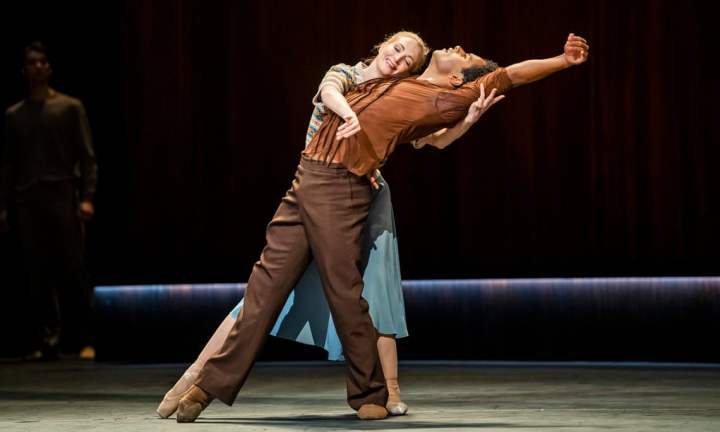
By making the cello a dancer, Marston is free to express the relationship Jacqueline had both with her instrument and with music in dance. You see them dancing together and it makes perfect sense, a musician at one with her instrument. The instrument as an extension of her body. (And, in ballet, thebody as instrument.) At the beginning, with Jacqueline as a young girl, the cello seems to almost be a force in and of itself, drawing her to it. The cello wants Jacqueline to take up the instrument as much for her as for it—she brings it to life by making music with it. When Jacqueline plays her cello, she always begins with proper form, as if truly preparing to play. But within a few moments it becomes dancing, artist and instrument lost together in music. And at the end, when Jacqueline is confined to a chair, unable to play, it was the cello I grieved for.
Two years ago, I interviewed Marston. (Read the interview here.) I wrote that she “prefers not to rely solely on set pieces and props, instead asking, ‘How much can we challenge the audience to imagine?’ by creatively using simple objects and bodies to make meaning in dance.” Cello aside, that struck me early on in this ballet. There are barely any props, a few chairs and some records—but watch for dancers standing in for furniture, such as a record player, with a finger as the needle. It’s a very creative approach to storytelling and mime.
Sambé is wonderful, a rich, fluid mover who is perfectly cast as the cello. Cuthberston is always at her best when she gets to play a character, and by the end of the ballet you can see that she has lived every moment of Jacqueline’s story onstage. In the bows, be sure to watch the student who plays young Jacqueline—she appears to be living, and loving, her best life, and it’s so adorably genuine.
I thought the camerawork was often too busy. When I lose sight of the whole stage, I always wonder if I’m missing something important, or interesting, off camera. And when there’s a lot of movement going on, I find it much easier to watch from a bit of a distance. Up close, it can become unclear. Sometimes with theater dance you really need the perspective to “read” and understand the choreography.
Early on, I told you that you had a unique opportunity to see this ballet. There’s actually an additional unique opportunity, and that is to watch a Cathy Marston double feature. San Francisco Ballet is currently sharing her Snowblind online. Neither Snowblind, based on Ethan Frome, nor The Cellist is especially happy. If you’re looking for happy, mark your calendars for The Royal Ballet’s La Fille mal gardée on June 12.
The Royal Ballet: The Cellist
Watch on YouTube here until June 12
San Francisco Ballet: Snowblind
Watch on their website here through June 5 at 12 pm PDT
What I’ve Said Before
Jane Eyre (also choreographed by Cathy Marston)
In Conversation with Cathy Marston
Unbound
 Going to the Ballet