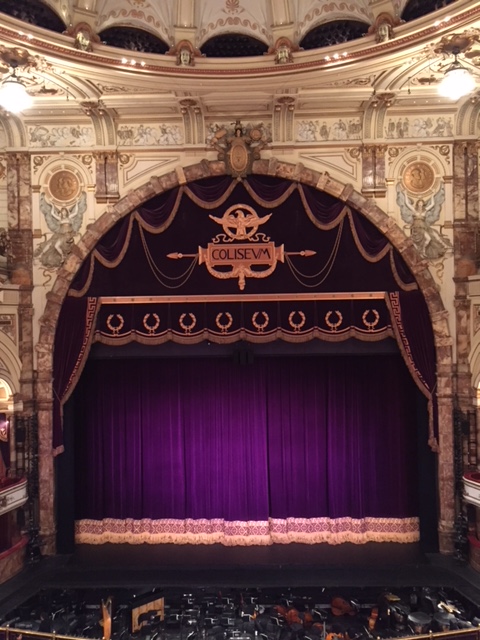
I walked into the theater at the London Coliseum and said, out loud, “Oh wow!” The venue opened in 1904 and is a grand Edwardian theater—nothing at all like what the term “coliseum” conjures in my mind. The space was certainly a fitting setting for English National Ballet’s run of The Sleeping Beauty.
Beautifully dressed and very well-danced, this was Kenneth MacMillan’s production of Sleeping Beauty. I didn’t even realize he had done a version of this ballet! I associate MacMillan so strongly with his own story ballets, with the high drama and heavy costumes of Manon, Mayerling, and Romeo and Juliet, that I was surprised he had touched this supremely classical work. However, according to the program, MacMillan loved Sleeping Beauty and considered it the cornerstone of ballet. MacMillan “said that he learned to choreograph by being in the production of The Sleeping Beauty that he first saw at Covent Garden in 1946. It taught him about structure, style, musicality, the length of each dance, the importance of the pas de deux, and where these should sit in relation to the supporting solos and group dances. He cared passionately that the classics should remain true to their original intent, with their pure classicism and clearly understood use of mime…The Sleeping Beauty shows the origins of the classical tradition, the standard to which a classical dancer must aspire, and from that bedrock how ballet can be an ever evolving and extraordinary art form” (Deborah MacMillan, April 2018; quote taken from the program for this production). This is high praise. It’s also true that ballet must, and has, evolved, as storytelling has. You can’t use the “pure classicism” of Sleeping Beauty to tell the story of Romeo and Juliet. But you do need dancers who have that foundation.
The role of Aurora was danced by Jurgita Dronina (also a principal with the National Ballet of Canada). She has a lovely bright, young quality about her dancing that perfectly suited Aurora, a freshness and lack of guile that is necessary to the character. She sailed through the Rose Adagio. Speaking of which, I took issue with one element of the staging there. In the Rose Adagio, Aurora dances with four princes, eligible royals her parents have arranged for her to meet so she can choose a husband. Generally, Aurora dances with all four princes more or less equally, not favoring any of them. Here, however, there was one prince who did most of the partnering, leaving the other three with nothing to do. This suggested that Aurora had made a choice, which she had not and does not.
The Lilac Fairy’s variation seemed fiendishly difficult, as well as being unfamiliar to me. The so-called “Canary Fairy” was particularly well-danced by Senri Kou and got a big round of applause. Skipping ahead to Act III, the fairy tale guests also got a happy reaction, as usual. I could do without Red Riding Hood, and to be entirely honest, without the White Cat and Puss in Boots as well. But that’s just me! The precious metals and gems are more my speed, and they were dispatched with aplomb.
It was a pleasure to see the company, which is very good. I dislike comparing companies in the sense of ranking them. The Royal Ballet is the more famous and lauded London-based ballet company (at least to me) but ENB is certainly not lesser. My only previous experience with ENB was several years ago when I saw their Romeo and Juliet in the round at Royal Albert Hall. Sitting up high, the view was quite terrible, as at least half of the stage was cut off at all times. I much preferred this venue!
As with San Francisco Ballet’s Sleeping Beauty earlier in the year, I was pleasantly surprised by how much I enjoyed this ballet. And yet, seeing Swan Lake two nights later, I was struck by how much more engrossing the latter is. The Sleeping Beauty simply does not transport the viewer in the same way; I’m not sure it can.
English National Ballet: The Sleeping Beauty
June 16, 2018, at 7:30 pm, at the London Coliseum
 Going to the Ballet